
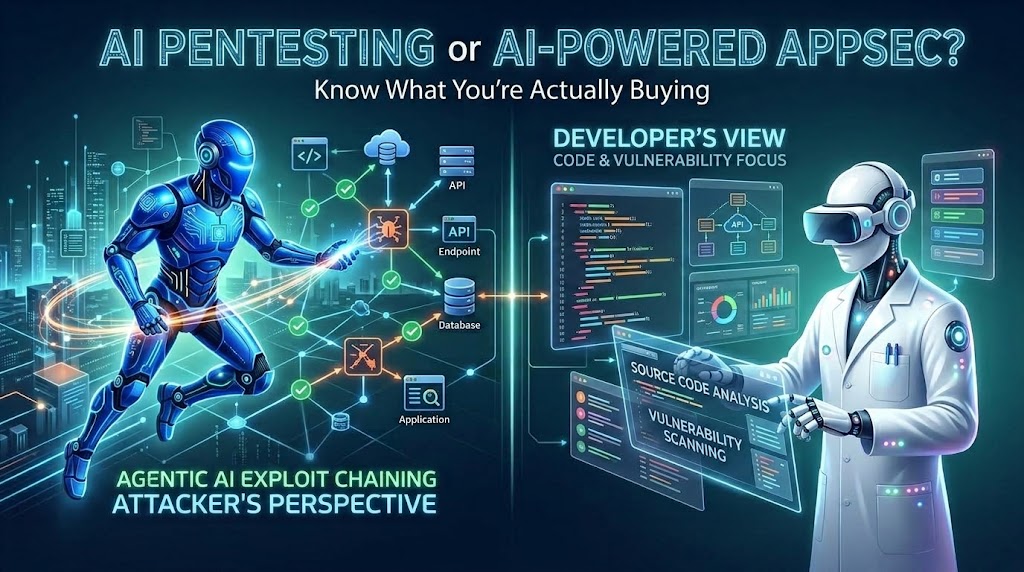
- The rise of agentic AI is creating new possibilities for security testing—and new confusion for security buyers.
The security industry is entering a new era of AI-powered security testing.
Agentic AI can reason through applications, identify vulnerabilities, generate exploits, adapt its approach, chain weaknesses together, and validate whether a vulnerability can actually be exploited.
That is a significant advancement.
But there is a problem emerging alongside it: the market is increasingly using “AI pentesting” to describe very different things.
Some vendors are applying AI agents to source-code analysis. Others are using AI to automate web application testing. Some combine application testing with exploitation and validation.
These are all valuable capabilities.
But they are not necessarily the same thing as penetration testing.
For security leaders evaluating these technologies, the important question isn’t simply:
“Does it use AI?”
The more important questions are:
“What does it actually test?”
“From whose perspective is it testing?”
“Can it prove what an attacker can actually reach and exploit?”
That distinction matters.
Because penetration testing is not simply about finding vulnerabilities. It is about understanding and validating exposure in the environment that is actually running.

The Code Is Not the Environment
There is considerable overlap between source-code analysis and penetration testing. Both can identify vulnerabilities and flaws. Both are important parts of a modern security program.
But they start from fundamentally different perspectives.
Source-code analysis asks:
What could be wrong in this software?
Penetration testing asks:
What can an attacker actually reach, exploit, and do?
A production application does not exist in isolation.
It runs on operating systems, hosts, containers, databases, cloud infrastructure, identity systems, networks, APIs, third-party components, and security controls.
A vulnerability can exist in source code without being reachable by an attacker.
And significant exposure can exist without being caused by a source-code defect at all.
Consider a few examples:
- An exposed administrative service
- A missing operating-system patch
- A default credential
- An overly permissive firewall rule
- An incorrectly configured cloud resource
- An exposed database
- Weak network segmentation
- Excessive Active Directory privileges
- An API exposed through an unexpected route
- A compromised credential that provides access to another system
These are not necessarily problems that source-code analysis can identify.
They are characteristics of the running environment.
This is one of the fundamental reasons penetration testing remains distinct from source-code scanning.
A Real Attack Doesn’t Stop at the Application
Perhaps the biggest difference becomes apparent when we stop looking at vulnerabilities individually and start looking at attack paths.
An attacker doesn’t care whether a vulnerability is categorized as an application vulnerability, network vulnerability, configuration issue, or identity weakness.
They care about one thing:
Can I use what I have discovered to get somewhere I shouldn’t be?
An attack might look like this:
Internet → Web Application → Server → Internal Network → Domain Account → Critical System
There may be several individual weaknesses along this path.
None may look particularly significant when examined independently.
But together, they can create a serious exposure.
This is why exploit chaining is such an important characteristic of penetration testing.
A pentest doesn’t simply ask, “Is this vulnerability exploitable?”
It asks:
“If I exploit this vulnerability, what can I do next?”
And then:
“What can I reach from there?”
That is the difference between a vulnerability-centric view and an attacker-centric view.
Where Agentic AI Changes the Game
This is also where agentic AI has the potential to fundamentally change automated offensive security.
Traditional security tools tend to evaluate vulnerabilities individually.
Agentic systems can reason across multiple steps.
An agent can:
1) Discover an exposed application.
2) Identify a weakness.
3) Attempt exploitation.
4) Obtain access to the underlying host.
5) Enumerate the environment.
6) Discover neighboring systems.
7) Identify another exploitable weakness.
8) Attempt lateral movement.
9) Determine whether privileged access or sensitive assets can be reached.
The important capability isn’t simply that AI can execute an exploit.
It is that the system can reason about what happens next.
This is the direction Ridge Security is taking with RidgeGen.
RidgeGen uses agentic AI to reason through multi-step attack scenarios, combine findings into attack chains, validate exploitation, and examine whether compromised assets can provide pathways to other systems.
The objective is not to produce another vulnerability list.
It is to understand the exposure created by the combination of vulnerabilities, configurations, identities, network relationships, and security controls.
Finding a Vulnerability Is Not the Same as Proving Exposure
This distinction is particularly important when evaluating AI-powered security products.
A source-code scanner may identify a potentially vulnerable function.
A vulnerability scanner may identify a vulnerable software version.
An AI system may identify a suspicious authentication flow.
Those findings can all be valuable.
But they don’t necessarily answer the most important question:
Can an attacker actually reach and exploit it?
A penetration test attempts to answer that question through controlled exploitation.
That is why evidence matters.
A meaningful security finding should ideally tell the security team:
- What was discovered
- Where it was discovered
- How it was reached
- How it was exploited
- What access was obtained
- What additional systems became reachable
- What impact could be demonstrated
- What evidence supports the conclusion
There is a significant difference between:
“This could be exploitable.”
and:
“We demonstrated that an attacker can exploit this and reach these assets.”
For security teams responsible for reducing exposure, that distinction is critical.
CVSS Doesn’t Tell the Whole Story
The same issue appears when organizations prioritize vulnerabilities.
Security teams today can have thousands—or even millions—of vulnerability findings.
They cannot remediate everything immediately.
So the practical question becomes:
Which vulnerabilities create the greatest actual exposure?
CVSS provides a standardized way to describe vulnerability severity. But a severity score alone does not necessarily tell an organization whether a vulnerability is reachable from an attacker’s position or whether it can be chained with other weaknesses.
Consider two hypothetical findings.
Finding A
- High CVSS score
- Internal only
- No viable route from an attacker
- Strong compensating controls
- No meaningful attack path
Finding B
- Moderate CVSS score
- Internet reachable
- Exploitable without authentication
- Provides access to a privileged service
- Creates a path toward sensitive systems
The numbers alone don’t tell the entire story.
Security teams need to understand exploitability, reachability, attack paths, and potential impact in the context of their actual environment.
That is one of the central ideas behind Continuous Threat Exposure Management.
The goal isn’t simply to know what vulnerabilities exist.
It is to understand which exposures matter most in the real environment.

The Attacker’s View vs. the Developer’s View
Another way to understand the difference is to look at the perspective each methodology provides.
- The developer’s view
Source-code analysis provides deep visibility into the application itself.
It can identify:
- Vulnerable code
- Insecure coding patterns
- Data-flow problems
- Authentication and authorization issues
- Unsafe functions
- Business-logic flaws
- Code paths that may never be exercised during a dynamic test
This is extremely valuable.
In fact, source-code analysis is particularly powerful early in the development lifecycle because it can tell developers exactly where a problem exists and what needs to be changed.
- The attacker’s view
Penetration testing starts from the environment an attacker actually encounters.
With black-box testing, the tester begins from an external perspective, with little or no privileged knowledge.
This can reveal:
- Internet-facing exposure
- Exposed services
- Authentication weaknesses
- Firewall behavior
- WAF and IPS controls
- External attack paths
- Misconfigurations visible from outside
With gray-box testing, the tester has some legitimate access or credentials.
This can simulate:
- A compromised employee account
- A stolen credential
- An insider
- A compromised application identity
It answers a different question:
What can an attacker do after gaining initial access?
Both perspectives are important.
And neither should be confused with source-code analysis.

White-Box, Black-Box and Gray-Box Are Complementary
This is why the discussion shouldn’t become a debate over whether source-code analysis or penetration testing is better.
They solve different problems.
White-box testing can provide deep visibility into the application and identify vulnerabilities that dynamic testing may never reach.
Black-box testing provides an external attacker’s perspective.
Gray-box testing shows what could happen after an attacker obtains some level of legitimate access.
A mature security program benefits from all three.
The mistake is assuming that one methodology automatically replaces the others simply because AI has been added.
So, What Should “AI Pentesting” Actually Mean?
AI can dramatically improve security testing.
It can make testing faster.
It can expand coverage.
It can reason through complex attack paths.
It can adapt to changing conditions.
It can chain vulnerabilities.
It can generate and validate exploits.
It can continuously retest an environment.
But adding an AI agent to a security product does not, by itself, define the scope of penetration testing.
The methodology still matters.
The coverage still matters.
The attacker perspective still matters.
The evidence still matters.
And the ability to demonstrate real-world exposure still matters.
That is why security buyers should look beyond the label.

Ten Questions to Ask Any Vendor Claiming “AI Pentesting”
Before buying an AI-powered penetration-testing solution, security leaders should ask some very practical questions.
1. What assets can you actually test? Does the platform test only web applications and APIs, or can it also test hosts, operating systems, network services, Active Directory, cloud infrastructure, containers, IoT/OT, and other enterprise assets?
2. What attacker perspectives are supported? Can it perform external black-box testing, internal testing, authenticated testing, and gray-box testing?
3. Can it test beyond a single application? Can it identify relationships between an application and the infrastructure around it?
4. Does it actually exploit findings? Or does it primarily infer exploitability from source code, configurations, signatures, or vulnerability databases?
5. Can it chain vulnerabilities? If vulnerability A provides initial access, can the system use that access to discover and exploit vulnerability B?
6. Can it demonstrate lateral movement? Can the system determine whether compromising one asset creates a path to another?
7. What evidence does the finding contain? Can the security team see exactly what was reached, exploited, and demonstrated?
8. How is risk prioritized? Is prioritization based primarily on static severity scores, or does it incorporate actual reachability, exploitability, attack paths, and demonstrated impact?
9. Can the agent adapt? If an attack path fails, can the system reason about alternative approaches rather than simply executing a predefined test?
10. What controls govern the AI? How are testing scope, credentials, destructive actions, agent permissions, and evidence controlled and audited?
These questions are much more meaningful than simply asking whether a product uses AI.
AI Should Make Pentesting More Powerful—Not Redefine It
There is enormous potential in agentic AI for offensive security.
But the industry should be careful not to let terminology create false equivalence.
Source-code analysis is valuable.
Application security testing is valuable.
Vulnerability scanning is valuable.
Penetration testing is valuable.
They overlap, but they are not the same.
The real opportunity with agentic AI is to bring these capabilities together while preserving the fundamental objective of offensive security:
Think like an attacker. Test the real environment. Follow the attack path. Prove what is exploitable. Understand the potential impact.
That is the philosophy behind RidgeGen.
RidgeGen is designed to move security validation beyond simply identifying vulnerabilities. It uses agentic reasoning to discover, validate, chain, and investigate attack paths across the environment—helping security teams understand not just what is vulnerable, but what an attacker can actually reach and do.
Because ultimately, a vulnerability is a data point.
An attack path is an exposure.
And proving the difference is what security validation is all about.
Find. Prove. Fix. And Prove It Again.