About This Episode
A penetration test only matters if it leads to change. Finding weaknesses is the first step. The team also has to understand what was found, fix it, and prove the fix worked. AI pentesting can make that cycle faster, but pentest remediation is still where the real security gains happen.
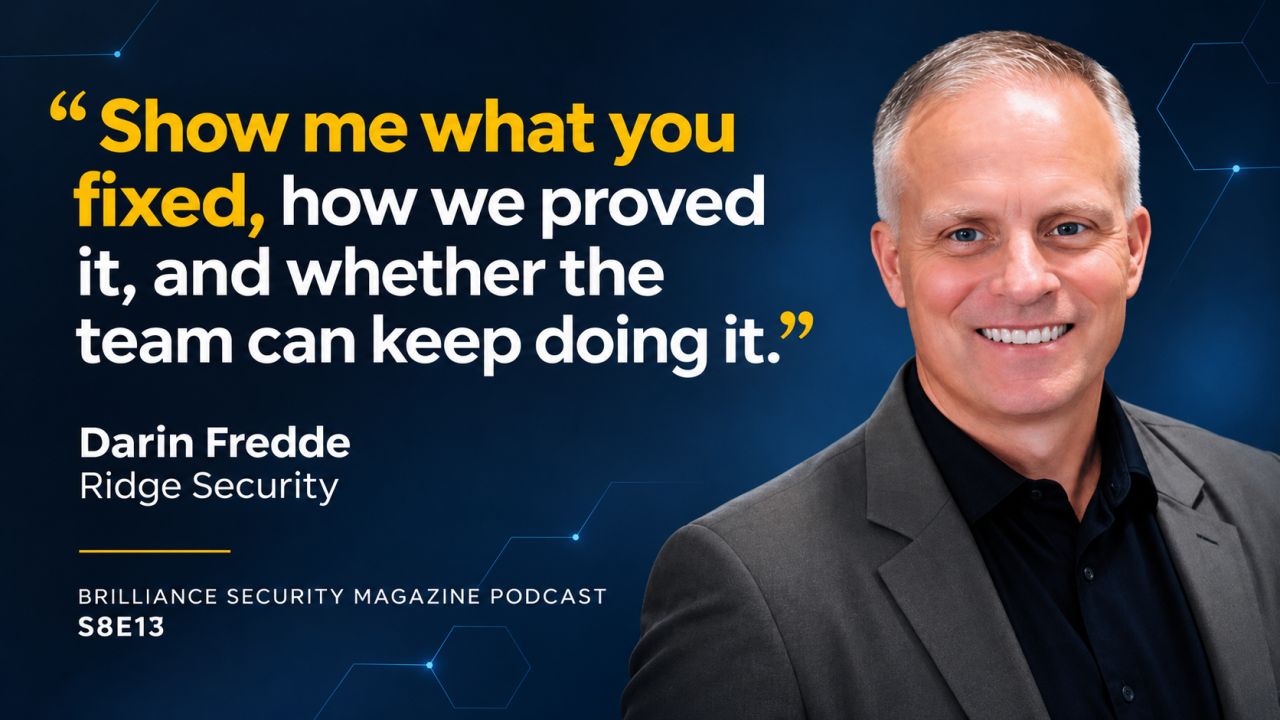
Darin Fredde, Senior Director of Technical Marketing Engineering and Offensive Security Evangelist at Ridge Security, joined host Steven Bowcut on this episode of the Brilliance Security Magazine Podcast. They talked about how AI pentesting can make that whole cycle work better. Darin has worked in enterprise security architecture, penetration testing, and cybersecurity education. He explains how organizations can test more often without losing control of sensitive data or testing boundaries.
What Darin Covered
1) From Trade School to Offensive Security
Darin talks about his unusual route into cybersecurity, from trade school and computer-aided design to technology leadership and enterprise offensive security. That path made him focus on the gap between how secure an organization thinks it is and what testing actually shows. He believes a good assessment gives the people who build and run systems evidence they can use to improve them.
2) Why Testing Has to Keep Up
An organization’s exposure can change between scheduled assessments. A new application, an extra permission on a service account, or a new connection between systems is enough. Darin explains how testing more often lets teams see those relationships and confirm that a fix actually closed the original weakness.
3) Introducing RidgeOne
Darin walks through RidgeOne, an appliance that pairs our RidgeGen platform with an AI model running locally. The model does the reasoning. The platform runs the tests, enforces the controls, and records the evidence. Because everything is processed on site, AI-assisted assessments are easier to approve and deploy in sensitive or restricted environments.
4) Protecting Assessment Data
Keeping the model on premises is only part of the job. Darin shares a story from a school district engagement where a pen-test report reached a student, who then used it as a roadmap. He urges security teams to check how their credentials, logs, reports, backups, and support processes handle sensitive information. He also explains SafeBox, our approach to keeping credentials out of the model’s readable context.
5) Remediating Connected Findings
Darin uses a practical example to show why linked findings need attention together. Exposed credentials can lead to excessive permissions, and those permissions can lead to sensitive data. He walks through the fix from start to finish. The team shuts off the immediate access, rotates the credentials, and reviews sessions and tokens. Then it reduces permissions, corrects how the application handles secrets, and verifies the results.
6) Keeping Humans In The Loop
Human judgment matters at every stage. Darin covers what evidence should back an AI-generated finding and when application owners or human testers should review the conclusions. He also talks about setting rules of engagement, enforcing boundaries the model can’t override, and keeping a clear record of what was authorized and what happened.
7) Running a Pilot That Proves Value
The episode ends with advice on evaluating a pilot. Darin would count the usual costs of hardware, licensing, maintenance, and staff time. He would also measure assessment coverage, independently validated findings, time to verify remediation, analyst effort, and operational impact. He would bring in defenders too, to see whether they detected the testing and responded better. His test for success is simple: show what the team fixed, how it proved the fix, and whether it can do it again.