
1. Executive Summary
In April 2026, Anthropic previewed Claude Mythos — an advanced AI system capable of discovering complex vulnerabilities in production-grade code, developing working exploits on the first attempt in over 83% of cases, and uncovering a 27-year-old vulnerability in OpenBSD during pre-release testing. It followed a string of similar milestones: Google Big Sleep intercepted a live zero-day exploit in SQLite before any human defender, DARPA’s AIxCC demonstrated end-to-end autonomous vulnerability discovery and patching, and AI-orchestrated offensive activity has been observed in the wild at scale.
The security industry’s response has been predictable. Some call it the end of traditional defense. Others call it marketing theater. Both miss the point.
AI has genuinely changed offense. But most of the conversation around Mythos focuses on the wrong question — can AI find bugs? The answer is yes, and it has been yes for years. The more important questions are:
- If AI finds old bugs, why is it simultaneously writing thousands of new bugs into production code every day?
- When attackers use AI to find one working path into your environment, what does your defense look like?
- Before worrying about the vulnerabilities Mythos will disclose tomorrow, do you know which of your existing vulnerabilities are reachable and exploitable right now?
- Will the next generation of AI models replace the dedicated security products organizations have invested in?
This paper argues that the arrival of Mythos-class capabilities does not make traditional security obsolete. Instead, it makes one discipline more critical than ever: continuous, autonomous security validation. Not because AI changes the defender’s fundamental asymmetry — but because it widens it, and only continuous validation closes that gap.
2. What Mythos Actually Represents
Let us be clear about what has changed.
AI systems can now find real, exploitable vulnerabilities in complex software faster than human researchers and at scale. Anthropic’s internal testing found Mythos identified thousands of previously unknown zero-day vulnerabilities across every major operating system and every major web browser — bugs that survived decades of human security review and millions of automated tests.
Google’s Big Sleep made history in July 2025: it detected and intercepted CVE-2025-6965 — a critical integer overflow in SQLite — before any public exploit surfaced. This was the first confirmed case of an AI agent directly foiling a zero-day exploit in the wild. In August 2025, Big Sleep found a critical use-after-free in Chrome’s ANGLE graphics library (CVE-2025-9478, CVSS 9.8), again before human researchers.
DARPA’s AIxCC competition, concluded in August 2025, demonstrated that AI systems can autonomously discover and patch vulnerabilities in critical infrastructure code without human guidance. Independent research by Daniel Kang demonstrated that GPT-4 could exploit known software vulnerabilities autonomously with an 87% success rate at a cost of $8.80 per exploit.
This is not theater. It is real. But it is not entirely new.
Finding bugs in open source code has been possible for decades through static analysis, fuzzing, and skilled manual research. The real shift is not that AI can find bugs. It is that AI can find bugs, generate exploit code, correlate across targets, and chain attack paths continuously — at machine speed.
Key Shift: The Automation of the Full Offensive Workflow
The dangerous innovation is not vulnerability discovery in isolation. It is the end-to-end automation of: reconnaissance → discovery → exploit generation → attack path chaining → lateral movement — operating continuously, with no human in the loop.
The defender must now operate on the same premise: continuously, inexpensively, and at comparable speed.

3. The Exploitation Timeline Collapse: Numbers Defenders Must Know
The speed asymmetry between attackers and defenders has been widening for years. AI has turned a trend into a structural crisis. The Zero Day Clock — which tracks time-to-exploit across more than 83,000 CVE-exploit pairs drawn from CISA KEV, VulnCheck KEV, and XDB — tells a story that reframes every vulnerability management conversation.
2018 median TTE: 771 days — organizations had over 2 years to patch
2021 median TTE: 84 days — 9× compression in 3 years
2023 median TTE: 6 days
2024 median TTE: 4 hours
2025 — majority of CVEs: Weaponized before public disclosure
2026 zero-day rate: 67.2% of exploited CVEs are zero-days (up from 16.1% in 2018)
Average org patch time: 20 days to test and deploy a single patch
CISA KEV remediation: 55 days to remediate 50% of known-exploited vulnerabilities
Pre-disclosure exploitation: ~30% of CISA KEVs exploited on or before the day the CVE was published
CVE volume growth: 40,000+ CVEs in 2024 — a 520% rise over a decade
The math is unambiguous: when attackers weaponize vulnerabilities in hours and defenders need 55 days to remediate 50% of critical findings, the traditional disclosure-to-patch model has inverted. When a vendor releases a security patch, AI can now reverse-engineer it, identify the underlying vulnerability, and generate a working exploit — in minutes. Attacks can begin propagating within hours. The entire model our security programs were built around no longer holds.
4. The Other Side of Mythos: AI Is Writing Vulnerable Code at Scale
There is a second story receiving far less attention. The same AI systems that find vulnerabilities are also writing a very large amount of new vulnerable code into production, every day.
Veracode (Sep 2025): 45% of AI-generated code samples failed security tests and introduced OWASP Top 10 vulnerabilities
Apiiro (Sep 2025): AI-generated code produced ~10× more security findings per month by mid-2025 vs. late 2024
CodeRabbit (Dec 2025): AI-authored code had 1.7× more major issues: improper authentication, IDOR, XSS
ProjectDiscovery (Apr 2026): 66% of security practitioners spend more than half their time manually validating findings, not fixing them
“AI finds old bugs” gets the headlines. “AI ships new bugs” gets a footnote.
There is a reason: finding old bugs makes for a compelling demo; fixing new bugs is Jira tickets. But the security consequence is severe. Defenders are now facing two simultaneous and compounding challenges:
Challenge 1 — Offense is accelerating. AI-driven attackers can identify viable paths into environments at machine speed, chain multi-step exploits autonomously, and move from disclosure to weaponization in hours.
Challenge 2 — The attack surface is spreading. AI-generated code is expanding the defender’s exposure faster than traditional AppSec programs can manage. Every sprint cycle adds new vulnerabilities that conventional scanners struggle to prioritize.
Mythos makes the first problem more visible. Applied to increasingly AI-generated codebases, it compounds the second problem. This is the double asymmetry AI has introduced — and it is the reason continuous, automated validation is no longer optional.
The Double Asymmetry: Attackers find more, faster. Defenders inherit more to defend, slower.
5. What AI Has Not Changed: The Defender’s Asymmetry
The asymmetry between attackers and defenders remains unchanged — and is now amplified.
An attacker needs to find one working path. One exploitable vulnerability. One misconfigured asset. One forgotten service account. One unpatched middleware instance. That is all.
A defender needs to know about all of them. Every vulnerability in every system, validated for real-world exploitability in the context of their specific environment. Every change, every deployment, every third-party integration — continuously.
The industry’s response for the last two decades has been to add more visibility — more scanners, more SIEMs, more EDR, more cloud posture tools. Every new tool generates more signals, but not necessarily clarity. The Cyentia Institute found that organizations can only remediate about 10% of new vulnerabilities per month, meaning exposure remains for 99.9% of the vulnerability lifecycle.
Most security leaders describe the same pattern: heavy investment in detection and observability that results in more alerts than their teams can act on. The gap between knowing a vulnerability exists and knowing whether an attacker can reach it in your environment has never been wider. And 92% of vulnerabilities on enterprise dashboards are, in context, pure noise — not reachable, not exploitable, not a real risk.
AI widens this gap. Attackers can now search the possibility space faster than defenders can investigate their own alerts. What defenders need is not more signals, but a decision layer: one that translates raw signals into validated, prioritized, actionable risk. That shift begins with a different question: not “does this vulnerability exist?” but “can it actually be used against me, right now?“
6. Why Finding Is Not Defending
Three observations from real enterprise environments highlight the limitations of traditional vulnerability management:
Finding is not the same as validating.
A high CVSS score does not mean an attacker can reach the vulnerable component. Lower CVSS scores can still be critical in chained attacks — and many enterprise VM programs prioritize incorrectly as a result. The ProjectDiscovery 2026 AI Coding Impact Report found two-thirds of security practitioners spend more than half their time manually validating findings — not fixing vulnerabilities. That is the definition of a broken prioritization model.
Validating once is not the same as validating continuously.
Periodic penetration tests provide a snapshot, while your environment changes daily. An attack path that did not exist last quarter exists today — introduced by a new deployment, a cloud misconfiguration, or a third-party component. You will not know about it until your next scheduled test. Or until an attacker tells you, by breaching.
Validating your own environment is not the same as validating your supply chain.
This is especially true in Asia and other fast-growing markets, where supply chains are hyper-connected and oversight is fragmented. Vendor attestations rarely reflect real exploitability. A supplier’s risks become your risks — immediately, and without notification.
Real-World Example: The n8n Chained Exploit (January 2026)
In January 2026, Ridge Security’s research team documented a chained vulnerability attack against n8n, a widely deployed workflow automation platform. The chain combined two CVEs that, individually, appeared limited in severity:
CVE-2026-21858: Arbitrary file read via Content-Type confusion — attacker reads local disk files including encryption keys
CVE-2025-68613: Expression injection → Remote Code Execution via Node.js sandbox escape
Combined impact: Full workflow takeover: file read → credential decryption → admin session → RCE
Traditional scanner result: Flagged both CVEs independently; could not determine if exploit chain was reachable
RidgeBot result: Confirmed full exploit chain end-to-end with zero false positives; no system state altered
This is the pattern real attackers use: chain small weaknesses into complete compromises. Version-based and signature-based scanners see each finding in isolation. Neither can determine whether the entire exploit chain is reachable. RidgeBot’s exploitation-based approach confirms whether a vulnerability is not just present but actually exploitable in its deployed context.
7. Continuous Threat Exposure Management: From Framework to Operational Practice
The industry term for addressing the validation gap is Continuous Threat Exposure Management (CTEM), introduced by Gartner as a systematic approach to continuously scoping, discovering, prioritizing, validating, and mobilizing against exposures. It shifts the core question from “are we compliant?” to “are we actually defensible right now?”
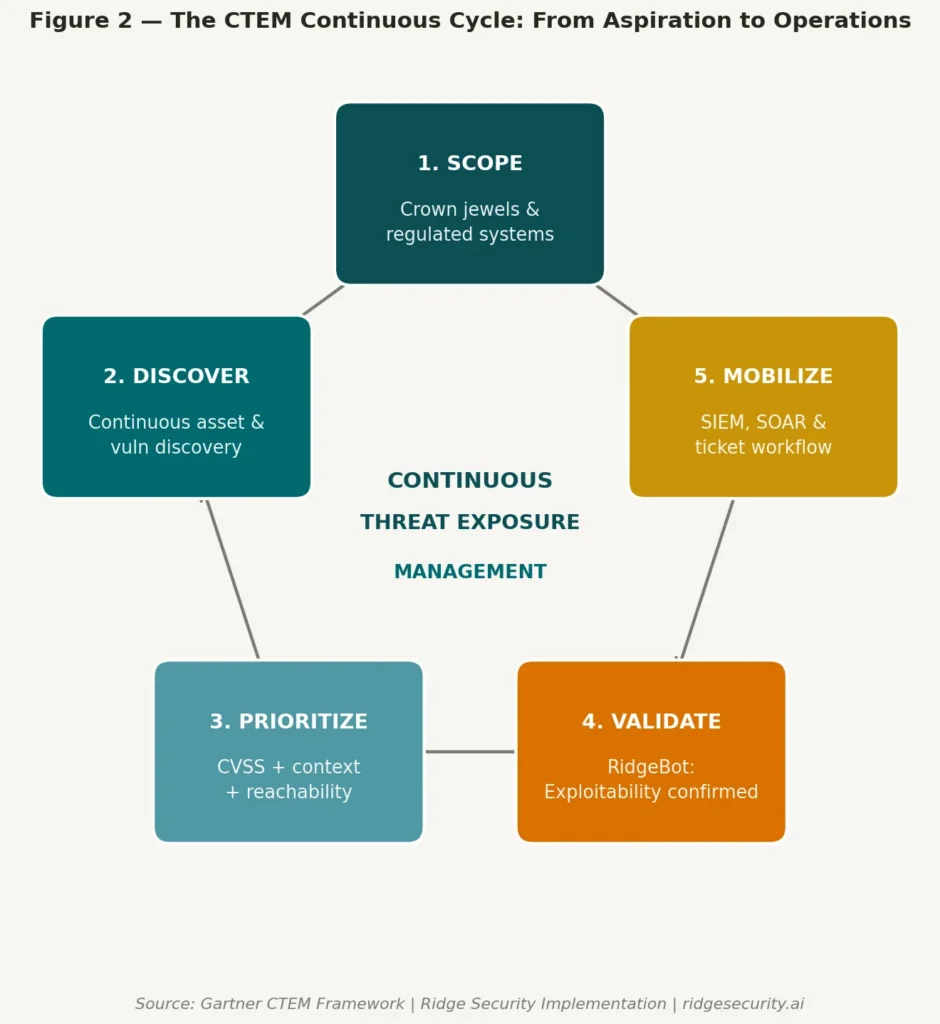
CTEM is not viable at enterprise scale without automated security validation — the engine that continuously tests exploitability in real environments. Each phase of the CTEM cycle depends on it:
Scope: Identify what matters most — crown jewels, regulated systems, internet-exposed infrastructure, supply chain connections.
Discover: Continuously inventory assets and map vulnerabilities as the environment changes.
Prioritize: Rank exposures by combining CVSS score, business context, and actual reachability — not scanner volume.
Validate: Confirm exploitability through controlled, safe adversarial testing. This is where RidgeBot operates.
Mobilize: Feed validated findings directly into patching workflows, ticketing systems, and change management — automatically.
8. What Automated Security Validation Actually Does
Automated security validation is not a rebranded vulnerability scanner or a periodic penetration test. It is a continuously operating adversarial testing engine that performs three specific functions traditional security tools cannot:
It confirms exploitability in context.
Most vulnerabilities on a VM dashboard are not exploitable in a given environment — because the vulnerable component is not reachable, compensating controls are in place, or authentication blocks the attack path. Automated validation determines, empirically, which ones are exploitable by safely testing them in the authorized environment. This directly addresses the 92% noise problem.
It chains attack paths.
Real attackers rarely use a single vulnerability. They combine low-severity misconfigurations, medium-severity vulnerabilities, and weak credentials to reach a critical asset. Scanners see each finding in isolation. Automated validation simulates the full chain — revealing multi-step attack paths that are invisible to point-tool analysis but obvious to an adversary. The n8n example above is a live illustration.
It runs continuously.
Every infrastructure change, deployment, or patch is tested against current attack techniques. Security posture reflects current reality, not a months-old snapshot. This is what turns CTEM from aspiration to operational practice.
The output is not a longer list of CVEs. It is the opposite: a much shorter list of validated, chained, exploitable paths in priority order — the actual attack surface an adversary would use today. For a defender drowning in tens of thousands of raw vulnerability findings, this is the difference between noise and action.
9. AI on the Defender’s Side: RidgeBot in Practice
One more thing Mythos-class capabilities have changed: the economics of offensive testing. For most of this industry’s history, comprehensive offensive testing has been expensive, manual, and slow. Red team engagements cost six or seven figures, run for weeks, and produce a point-in-time report accessible only to the largest enterprises.
RidgeBot changes this dynamic. The same AI capabilities that empower attackers are deployed by Ridge Security — inside a controlled, authorized context. The cost of comprehensive adversarial testing drops significantly while speed rises. Testing that was previously quarterly becomes continuous. Testing that was previously limited to large enterprises becomes accessible to the mid-market and regional organizations.
Dual AI Engine Architecture
RidgeBrain — A TensorFlow-based AI engine that performs adversarial reasoning, attack path construction, and vulnerability chaining. RidgeBrain identifies reachable attack paths and prioritizes validated exploitability over raw scanner volume.
RidgeGen —An agentic AI-powered engine that reasons about application behavior, maintains a persistent world-model of the target, chains exploit autonomously, and guarantees every finding with execution evidence.
RidgeBot ACE: Adversary Emulation Aligned to MITRE ATT&CK
RidgeBot’s Adversary Cyber Emulation (ACE) module maps every assessment to MITRE ATT&CK tactics and techniques, deploying Botlet agents to simulate real adversary behavior across three critical domains:
Endpoint Security: Botlet simulates malicious software and malware signatures to validate EDR and AV controls.
Data Exfiltration: Simulates unauthorized movement of PII, financial, and source-code data from internal servers.
Active Directory Recon: Simulates attacker privilege escalation, persistence, and credential harvesting in Windows AD.
The key measurement is the Block Rate — the ratio of blocked assessment scripts to all scripts executed. Results are mapped per MITRE ATT&CK tactic, technique, and threat group, producing board-level evidence of security control effectiveness.
Case Study: Tocumen International Airport
Tocumen International Airport in Panama deployed RidgeBot to protect infrastructure ranging from baggage handling systems to IoT devices. Key outcomes:
- Zero false positives — every finding represented a confirmed, exploitable vulnerability
- Real-time reporting eliminated weeks-long wait times for penetration test results
- Cost reduction of up to 50% compared to equivalent manual testing
- Compliance evidence for BASC and industry security standards generated automatically
“We particularly appreciate RidgeBot’s zero false positives. It identifies exploitable vulnerabilities, validates, and provides evidence to substantiate those risks. RidgeBot’s real-time reporting means instant results rather than waiting weeks.” — Abdy Sanjur, Innovation Manager, Tocumen International Airport
Case Study: ASEAN Commercial Bank
An ASEAN commercial bank with over $1B USD in capital assets and one million clients deployed RidgeBot across internal servers and external websites. RidgeBot discovered and validated the EternalBlue vulnerability (the attack chain behind WannaCry ransomware) in their Windows 7 infrastructure. The Blue Team witnessed RidgeBot’s live exploitation, immediately remediated the risk, and exported evidence directly into their PCI DSS compliance reporting.
“We didn’t realize that pen-testing can be done so efficiently — automatically detecting vulnerabilities in our system and helping us maintain regulatory compliance through effective risk management.” — CISO, ASEAN Commercial Bank
10. Will the Next Model Replace the Security Product?
This is the fair question that follows every Mythos-class announcement. The short answer: no — and the reasoning matters.
A foundation model is an engine. Powerful, and getting more powerful every quarter. But an engine is not a product. A security product is the engine plus the scaffolding that makes it safe, controlled, and operationally useful inside a real enterprise. Four pieces of that scaffolding matter most, and none are solved by a better model:
The Harness. You cannot point a raw LLM at a production environment and allow it to operate freely. Real offensive testing requires an authorized, sandboxed execution harness — one that controls what the AI can touch, enforces scope boundaries, preserves evidence, prevents collateral damage, and maintains audit trails that can stand up to a regulator. Building this harness is the hard engineering problem. The model is the easier part.
Memory Built for Offensive Security. Offensive security is not a stateless task. It must track reconnaissance findings, credentials discovered, lateral movement opportunities, privilege escalation paths, and how individual low-severity findings chain into exploitable paths across a specific environment. This form of attack-path reasoning requires memory structures purpose-built for the problem. General-purpose models are not designed for this.
Privacy and Confidentiality of Customer Data. Enterprise security testing touches an organization’s most sensitive information — asset inventories, credentials, internal network topology, and exploitable paths. Defenders cannot hand this data to a general-purpose model that may train on it or transmit it across uncontrolled boundaries.. For regulated industries and government customers, this is not a feature — it is a precondition.
Enterprise Workflow Integration. A security product must integrate with SIEM, SOAR, ticketing, patching pipelines, compliance frameworks, and change management processes. It must scale across large, distributed environments and produce evidence that security teams can defend in front of the board, the auditor, and the regulator. None of this is the model’s job. All of it is the product’s job.
Ridge Security is not competing with foundation models. They use them.
Every significant advance in AI capability — including Mythos-class reasoning — makes Ridge Security platform more powerful, not less relevant. RidgeBot, powered by the dual AI engine, is designed to leverage state-of-the-art AI models as they become available, inside a harness and memory architecture built specifically for offensive security.
The model is the commodity. The product is the scaffolding. The scaffolding is what enterprise defenders actually need.
11. A Practical Path Forward
For security leaders, the practical question is not whether to adopt AI, but how to apply AI-driven validation within an existing stack — without creating yet another dashboard for the team to ignore. Three principles, based on what we observe working in the field:
Start with exploitability, not volume.
Do not try to validate every finding from every tool. Start with the assets that matter most — crown jewels, regulated systems, internet-exposed infrastructure, and supply chain connections. Expand from there. The goal is a shorter, higher-confidence list of validated attack paths, not a larger list of potential exposures.
Integrate validation into remediation, not reporting.
Validation should feed directly into patching workflows, ticketing systems, and change management. Validated, exploitable findings should move quickly. Unvalidated or unreachable findings should be deprioritized automatically. The Mondoo 2025 State of Vulnerability Remediation Report found 62% of teams still use manual remediation workflows and only 2% are fully automated. That gap is where breaches occur.
Measure the right things.
Not the number of vulnerabilities found, but: how quickly exposures are validated; how many exploitable attack paths are reduced; how fast environments are re-tested after change. These metrics reflect whether your security posture is actually improving — not just whether your scanner found more.
The Three Questions Every Security Leader Must Answer
Before evaluating any new security investment, every CISO and IT leader should be able to answer with confidence and evidence:
How often are you testing? If the answer is quarterly, annually, or ad hoc, your security posture between assessments is effectively unknown. With exploitation timelines measured in hours, threat actors do not wait for your next scheduled test.
Are you validating exploitability? Identifying vulnerabilities is not the same as understanding which ones are actually reachable and exploitable in your environment. Most organizations cannot answer this with confidence.
How fast can you respond? If your response requires manual triage, ticketing, and committee approval — your remediation time is measured in weeks. AI-driven exploitation is measured in hours. The math does not work.
If you hesitate on any of these three questions, the gap between what your security program assumes and what an adversary can actually do is measurable — and increasingly exploitable.
12. Closing
The Mythos moment is not the end of traditional security. It is not the arrival of a silver bullet for defenders either. It is a clarifying event — a signal that the asymmetry between attackers and defenders has widened, and that the slow, periodic, snapshot-driven security models that served this industry for two decades are no longer sufficient.
The data is unambiguous. Exploitation timelines have compressed from 771 days to sub-hourly. The zero-day rate has grown from 16% to 67% of exploited CVEs. AI-generated code is producing new vulnerabilities at 10× the prior rate. And two-thirds of security practitioners are spending more than half their time manually validating findings instead of fixing them.
Most of what the industry has debated about Mythos — whether AI can find bugs, whether this is marketing or substance, whether the next model will replace existing security products — misses the harder question: what do defenders do now?
The answer is not to buy more detection tools or generate more alerts. It is to close the gap between knowing and defending, continuously and at scale.
Automated security validation is the discipline that closes that gap. Scanners without validation produce noise. Detection without validation produces alert fatigue. Penetration testing without continuity produces snapshots that expire the moment they are delivered. Validation — automated, continuous, and exploitability-driven — is what turns a security program from a compliance exercise into a defense capability.
Mythos raised the offensive ceiling. The defender’s response is not to race AI against AI for its own sake. It is to rebuild the security program around what defenders have always needed and rarely had: continuous, evidence-based clarity about which of their thousands of potential exposures an attacker can actually use against them today.
That clarity is now achievable. It is also increasingly necessary.
Ridge Security | ridgesecurity.ai
References
1. Anthropic, Claude Mythos Preview, April 2026. https://red.anthropic.com/2026/mythos-preview/
2. Google Security Blog / Hackread, Big Sleep discovers Chrome ANGLE vulnerability (CVE-2025-9478), August 2025. https://hackread.com/google-big-sleep-ai-tool-critical-chrome-vulnerability/
3. DARPA, AI Cyber Challenge: Results, August 2025. https://www.darpa.mil/news/2025/aixcc-results
4. Veracode, 2025 GenAI Code Security Report, September 2025. https://www.veracode.com/genai-code-security-report
5. Apiiro, 4x Velocity, 10x Vulnerabilities: AI Coding Assistants, September 2025. https://apiiro.com/blog/ai-coding-security-risk
6. CodeRabbit, AI vs. Human Code Quality Analysis, December 2025. https://coderabbit.ai/blog/ai-code-quality
7. Hadrian.io, Understanding Negative Time-to-Exploit in 2025, October 2025. https://hadrian.io/blog/understanding-the-new-negative-time-to-exploit
8. ProjectDiscovery, 2026 AI Coding Impact Report, April 2026. https://www.prnewswire.com/news-releases/projectdiscoverys-2026-ai-coding-impact-report-302749706.html
9. Ridge Security, Chained Exploitation in n8n, January 2026. https://ridgesecurity.ai/blog/chained-exploitation-in-n8n-how-ridgebot-detects-real-world-workflow-takeover/
11. Gartner, Implement a Continuous Threat Exposure Management (CTEM) Program. https://www.gartner.com/en/documents/4227920
12. Mondoo, 2025 State of Vulnerability Remediation Report. https://mondoo.com/blog/2025-state-of-vulnerability-remediation-reveals-manual-processes-and-low-confidence
13. Daniel Kang et al., Exploiting LLM Vulnerabilities with GPT-4, 2024. https://arxiv.org/abs/2404.08144
14. Ridge Security, Tocumen International Airport Case Study. https://ridgesecurity.ai/customers-transportation/
15. Ridge Security, ASEAN Commercial Bank Case Study. https://ridgesecurity.ai/wp-content/uploads/ES-Commercial-Banking-CS-051622-min.pdf
16. Cloud Security Alliance, Mythos Ready v4, April 2026. https://labs.cloudsecurityalliance.org/research/ai-vuln-discovery-containment-claude-mythos-v1-0-csa-styled/
17. Zero Day Clock — Time-to-Exploit analysis.
18. MITRE ATT&CK Framework.
19. Verizon, 2025 Data Breach Investigations Report (DBIR). https://www.verizon.com/business/resources/reports/dbir/